Highlights
Mass Poetry Slam Team
Member
GrubStreet YAWP Fellow
Young Adult Writers Program
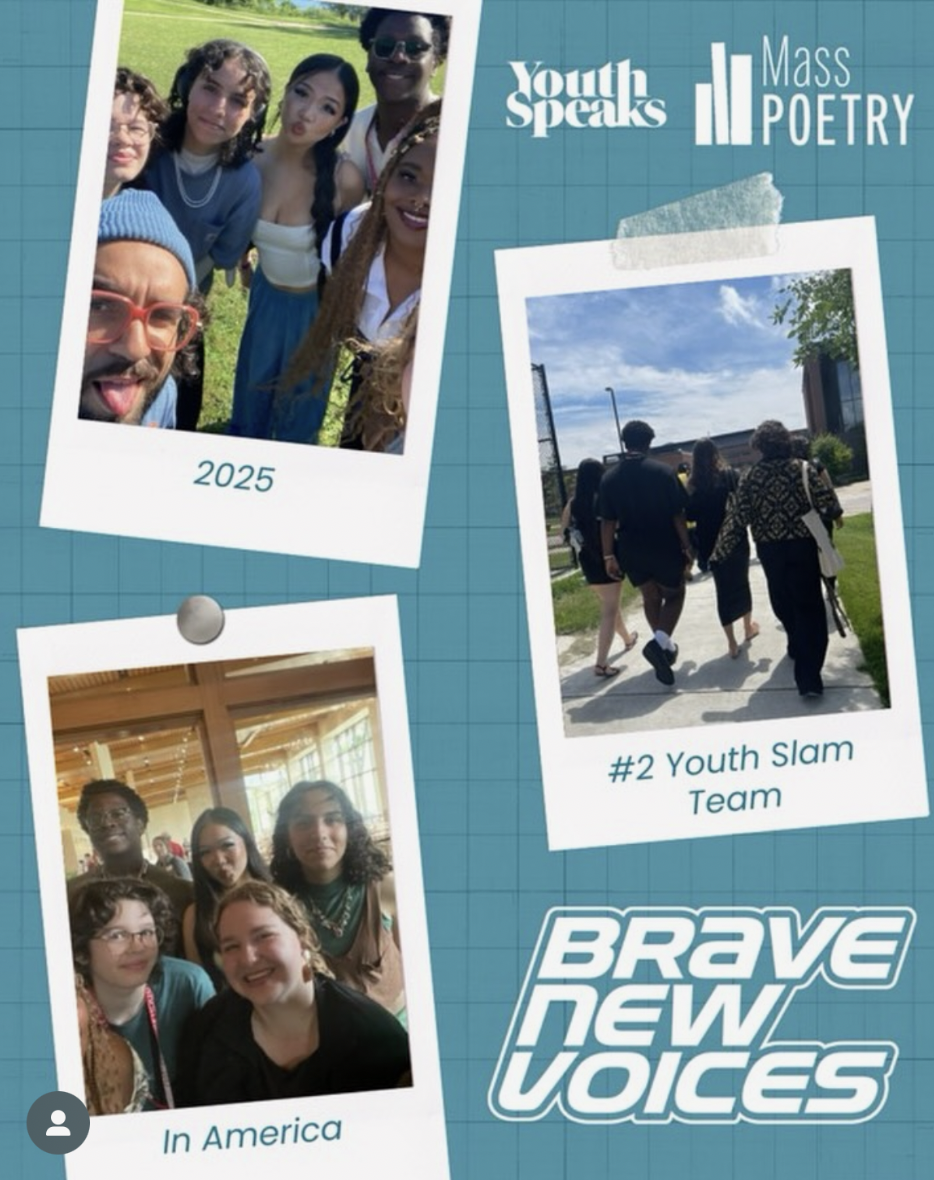
Brave New Voices Team
2nd place nationwide • 2025
Spoken word found me at a time when I needed a voice—not just to speak, but to be heard. There's something powerful about standing on a stage, sharing words that carry the weight of identity, climate justice, and community. Every poem is a bridge between my inner world and the outer world, between personal experience and collective understanding.
But what I love most isn't just the performance—it's the community. The poetry community I've found is unlike any other. It's a space where vulnerability is strength, where stories are sacred, and where young voices are amplified instead of silenced. Through Mass Poetry, GrubStreet, and Brave New Voices, I've met poets who've become mentors, friends, and collaborators. We lift each other up, challenge each other to grow, and create together in ways that feel revolutionary.
This community taught me that poetry isn't just art—it's activism, it's healing, it's connection. When I perform "How to Skin a Hurricane" or share pieces about climate justice and identity, I'm not just speaking for myself. I'm part of a movement of young people using our voices to demand change, to honor our ancestors, and to build a world where every story matters.
Member
Young Adult Writers Program
2nd place nationwide • 2025
Performed at Brave New Voices
Lao lao's ghost still sings to the mango tree
they paved into a Dollar General parking lot.
She taught me to read the sky's cursive—
how cirrus clouds curl like the language i forgot to speak,
how a monsoon's throat holds the grief
of a thousand unnamed islands.
"bao be" she'd say,
"when the ocean starts coughing up skeletons,
don't pray—organize."
But mama's spine is collapsing into high-rises,
condos blooming like tumors where the wetlands wept.
Last spring, the sea gnawed through our front door,
left salt scars on the photo albums,
yei yei's face dissolving into a blot.
FEMA said "rebuild," but the loans came shackled
to interest rates heavier than caskets.
Now we rent a studio where the roaches
write eviction notices on the walls.
In Houston, a boy floats face-down in a school gym,
his Spiderman backpack still humming
"It's a small world after all."
His mother claws at a National Guard Hummer"
her screams soldered into silence
a CNN ticker:
"Climate refugees swarm Louisiana coast—
when will the president act?"
Act?
The president's teeth are made of pipeline.
They'll mine our tears for lithium
before they admit the apocalypse
wasn't a prophecy—
just a spreadsheet.
At the border, a child tugs my sleeve,
her eyes two burned-out galaxies:
"为什么你看起来这么难过?" ("why do you look so sad?")
I want to tell her the truth—
that her mother's bones are now a dam in Arizona,
her father's laugh, a BP oil spill.
Instead, I empty my canteen into her palms,
watch her drink the future like blasphemy.
They call us "displaced."
As if we're luggage.
As if our grief isn't GPS-tagged,
our trauma tax-deductible.
ICE drones buzz overhead,
"This land is your land!"
a chorus that stinks of golf course and gasoline.
My cousin used to say hurricanes
are just the earth's way of vomiting
the poison we fed her.
He disappeared last August,
his fishing boat a coffin
for the last bluefin tuna.
The cops said "accident,"
but we know Exxon wrote the autopsy.
Tonight, I duct-tape my windows,
trace my daughter's face in the dark.
She asks why her asthma pump
sounds like a grenade pin dropping.
I don't say it's because the air's been mortgaged
to a coal baron's yacht fund.
Instead, I hum lao lao's mango tree song,
teach her to spell "revolution"
with a crayon on the moldy drywall.
"mama, will we always be drowning?"
"No, bao be. We're the ark.
And the storm?
It's just the world going into labor."
You want to know how to skin a hurricane?
First, you gotta stop flinching
when they call your pain "natural disaster."
Then, you arm your breath
with every name the ocean stole.
Finally—you rise.
Not as flood.
Not as corpse.
But as tide.